
Valves Manufacturer Tel: +86 13380377051
Regulators for High Purity Krypton in Laser and Lighting Applications
Krypton (Kr), a noble gas existing in trace amounts within Earth’s atmosphere (approximately 1 part per million), holds a position of disproportionate importance in advanced industrial and scientific applications. Its unique atomic properties—specifically its ability to emit and absorb energy at specific spectral lines—make it indispensable in two distinct fields: high-power lasers and specialized lighting.
In excimer lasers, krypton is combined with halogens (like fluorine) to produce Krypton Fluoride (KrF) lasers, which emit deep ultraviolet light essential for semiconductor lithography and delicate corneal surgery (LASIK). In lighting, krypton fills the envelopes of high-performance incandescent bulbs and fluorescent tubes, reducing filament evaporation and improving efficiency and color rendering. In both cases, the purity of the krypton gas is not merely a preference; it is a non-negotiable prerequisite for performance, safety, and equipment longevity.
The interface between the high-pressure gas cylinder and the application is the gas regulator. Far from being a simple valve, a regulator for high-purity krypton is a precision electromechanical device that must maintain the gas’s integrity while delivering it at a precise pressure and flow rate. This article explores the critical engineering challenges and design specifications of regulators used for high-purity krypton in these demanding environments.
The Critical Importance of Purity
To understand the design of a regulator, one must first understand the threat: contamination. High-purity krypton is typically supplied in cylinders at 99.999% (Grade 5) purity or higher. The impurities—trace amounts of water vapor (H₂O), oxygen (O₂), nitrogen (N₂), or hydrocarbons—can have catastrophic effects on downstream processes.
-
In KrF Lasers: The laser cavity requires an exact mixture of krypton, fluorine, and a buffer gas like neon. Fluorine is hyper-reactive. If the krypton stream carries even parts-per-million (ppm) concentrations of water vapor or hydrocarbons, these can react with the fluorine, forming compounds that absorb the laser beam, drastically reducing power output. Worse, they can create particulates that contaminate the delicate optics and electrodes, leading to arcing and premature failure of the laser module.
-
In Lighting: In incandescent or fluorescent lamps, trace impurities can alter the plasma chemistry. Oxygen can attack the tungsten filament or electrodes. Nitrogen, while sometimes used as a filler, can, if uncontrolled, affect the ionization potential and alter the lamp’s intended color temperature and efficiency. In essence, impurities kill the light output and drastically shorten the lifespan of the lamp.
Therefore, the regulator’s primary function extends beyond pressure control; it must act as a guardian of the gas’s purity from the cylinder valve to the point of use.
The Anatomy of a High-Purity Krypton Regulator
A standard industrial regulator, perhaps used for nitrogen in a tire shop, is unsuitable for krypton. The components that come into contact with the gas must be meticulously designed to prevent outgassing, adsorption, and leakage.
1. Material Selection and Construction (Wetted Parts)
The “wetted parts”—the components that physically contact the krypton stream—are the first line of defense. Common materials like brass or standard elastomers (rubber) are porous or chemically reactive on a microscopic level. They can trap moisture and air during manufacturing, which then slowly leaches into the high-purity gas stream over time.
For high-purity krypton, the standard is stainless steel, typically 316L. Its non-porous surface and high corrosion resistance prevent outgassing and chemical reactions. The internal surfaces are often subjected to electropolishing. This process smooths the metal at a microscopic level, eliminating crevices where contaminants could hide. It also creates a chromium-rich surface layer that is passive and inert.
The internal seals, diaphragms, and seat materials are equally critical. Instead of standard rubber O-rings, regulators use specialized polymers such as PCTFE (Polychlorotrifluoroethylene) or PEEK (Polyetheretherketone) . These materials have extremely low permeability and outgassing rates, ensuring they do not introduce hydrocarbons or absorb moisture that could later desorb into the gas stream.
2. Diaphragm vs. Poppet Design
The mechanism that controls the flow is another crucial differentiator.
-
Poppet and Spring Regulators: Common in less critical applications, these use a spring-loaded poppet that pushes against a seat. The stem of the poppet passes through a packing gland to the outside. This gland is a potential leak path and a source of friction and particle generation.
-
Diaphragm Regulators: For high-purity krypton, a diaphragm-sealed regulator is mandatory. Here, a flexible metal or elastomeric diaphragm isolates the internal gas path from the operating mechanism (springs and adjusting screw). This creates a hermetically sealed system. There is no dynamic stem seal that can leak. This design ensures that atmospheric gases cannot diffuse into the system and that process gas cannot leak out. This is paramount for safety, as krypton is stored at high pressure and, while non-toxic, is an asphyxiant in enclosed spaces.
3. Connections: The CGA and VCJ Standards
The points where the regulator attaches to the cylinder and the downstream line are vulnerability points.
-
CGA Inlet: The connection to the cylinder is governed by the Compressed Gas Association (CGA) standards to prevent mixing up gases. For krypton, the standard connection is CGA 580. This fitting is designed with a specific thread and nipple shape unique to inert and noble gases, ensuring a krypton regulator cannot be accidentally attached to an oxygen or hydrogen cylinder. The seal is typically achieved via a Teflon® or nylon gasket that is compressed to form a gas-tight seal.
-
Outlet Connections: For the downstream line, standard pipe threads are often avoided. Instead, high-purity systems utilize VCJ (Vacuum Coupling Radiation) fittings or similar face-seal fittings. These employ a metal gasket that is compressed between two conically shaped faces. When tightened, the gasket deforms, creating a metal-to-metal seal that is virtually leak-free and can withstand temperature cycling and vibration without loosening.
Two-Stage Regulation: The Quest for Stability
Krypton is used in processes that demand incredible pressure stability. An excimer laser’s performance is directly tied to the precise pressure and mixture of gases within its chamber. As gas is consumed from a cylinder, the pressure inside it drops. A single-stage regulator would allow this decreasing cylinder pressure to influence the outlet pressure, a phenomenon known as “droop.” As the cylinder empties, the outlet pressure would slowly rise, altering the laser’s operating conditions and ruining the process.
To combat this, high-purity krypton systems almost exclusively use two-stage regulators.
These devices effectively contain two regulators in one body.
-
The First Stage: This is a fixed-pressure regulator that reduces the high, variable cylinder pressure (up to 2000-6000 psi) down to a stable, intermediate pressure (e.g., 300 psi).
-
The Second Stage: This adjustable regulator takes the stable intermediate pressure and reduces it further to the precise working pressure required by the application (e.g., 15-100 psi for a lamp, or a specific vacuum for a laser mix).
Because the second stage always sees a constant inlet pressure from the first stage, its outlet pressure remains incredibly stable, regardless of whether the cylinder is full or nearly empty. This “lock-in” effect is essential for repeatable, high-quality results in both scientific and industrial settings.
Purge Capabilities and System Integration
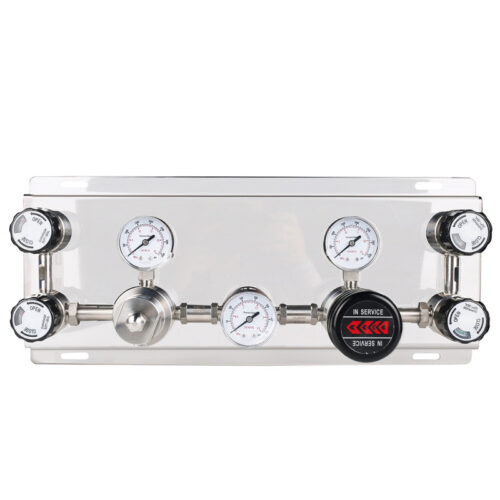
Installing a new cylinder introduces a contamination risk: air enters the regulator inlet when the cylinder is disconnected. If this air is pushed into the laser or lighting system, it spells disaster. Therefore, high-purity regulators are often integrated into a larger gas panel with purge features.
Many krypton-ready regulators feature an integrated purge valve. The correct installation procedure involves:
-
Attaching the regulator to the new cylinder.
-
Slightly opening the cylinder valve (with the regulator outlet closed) to pressurize the regulator inlet.
-
Opening the purge valve. The high-pressure krypton rushes through the regulator body and out the purge port, sweeping away any entrained air. This process is repeated multiple times to ensure the internal volume is pure krypton before the gas is ever sent downstream.
In more complex systems, such as those feeding a multi-chamber semiconductor tool, the regulator is part of an automatic change-over manifold with automatic purge cycles. These systems use a series of valves and regulators to switch between empty and full cylinders without ever exposing the process line to atmospheric contamination.
Safety and Environmental Considerations
While chemically inert, krypton poses physical safety risks that the regulator must manage. It is stored at extremely high pressures. Should a regulator fail—specifically, if its high-pressure seat fails to seal—the entire downstream system, which is designed for low pressure, could be exposed to full cylinder pressure. This could cause lines to burst, creating a projectile hazard and a rapid release of asphyxiating gas.
To prevent this, all quality high-purity regulators are equipped with an integrated pressure relief valve (PRV) . This device is set to open at a pressure slightly above the regulator’s maximum working pressure. If the regulator fails and pressure builds, the PRV safely vents the excess gas to a controlled location (often a dedicated exhaust or “scrubber” system in a fab environment), protecting the downstream equipment and personnel.
Conclusion
The incredible precision of modern laser eye surgery and the energy efficiency of advanced lighting systems are made possible by a chain of technologies, at the start of which lies a small, unassuming device: the gas regulator. For high-purity krypton, the regulator is not just a pressure knob; it is a critical component engineered to be an invisible enabler.
Through the use of electropolished stainless steel, advanced polymer seals, hermetically sealed diaphragms, and two-stage pressure design, these regulators ensure that the noble gas arrives at the point of use exactly as it was when it left the supplier—pristine and ready to perform. They are the silent guardians of purity, the stabilizers of pressure, and the critical interface that allows krypton to deliver its unique light and energy with precision and reliability.
For more about regulators for high purity krypton in laser and lighting applications, you can pay a visit to Jewellok at https://www.jewellok.com/ for more info.
-

Managing Hazardous Chemicals with a Custom Bulk Liquid Chemical Delivery System (BCDS) in Pharmaceutical Facilities
-
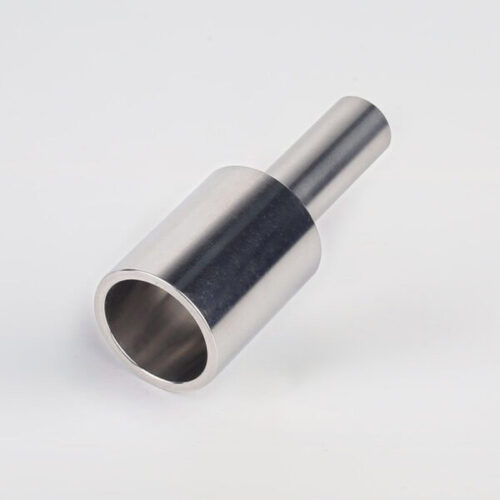
316L Stainless Steel Tube Butt Weld Reducing Fittings Union Reducer RW Series Ultrahigh Purity Process
-
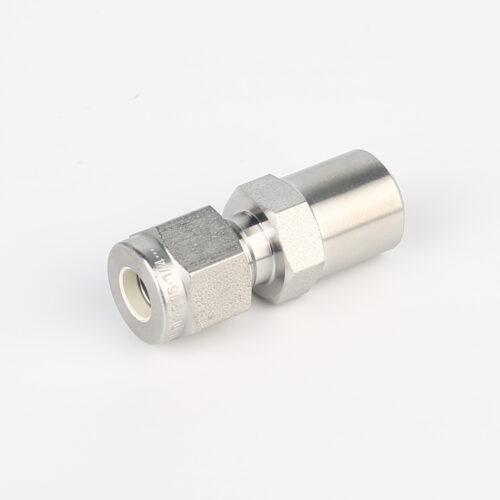
768LN Stainless Steel Male Pipe Tube Butt Weld Connector And Tube Fittings Supplier
-
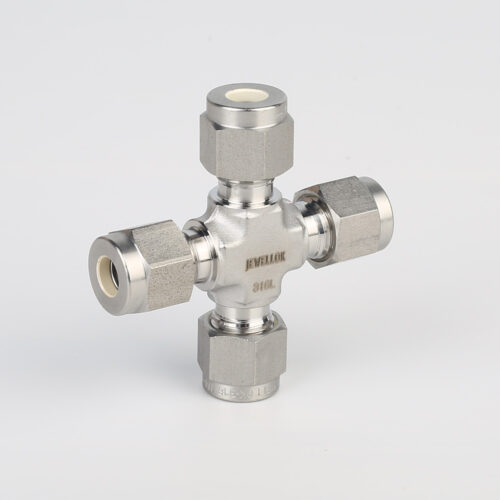
7102L Stainless Steel 316L SS Union Cross Ultra High Purity Long Arm Union Elbow Tee Cross Butt Weld Fittings
-
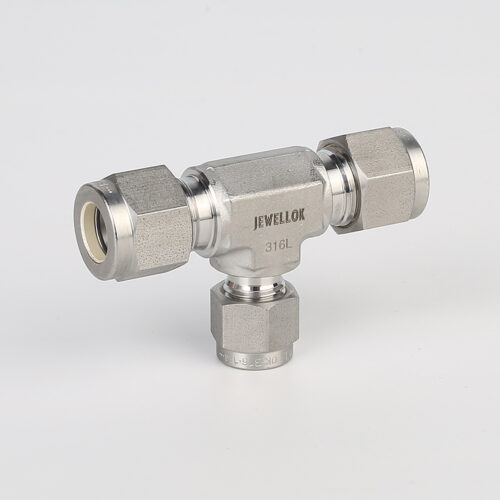
764LR Stainless Steel 316 Reducing Tee UHP Fitting Automatic Buttweld Reducing Tee
-
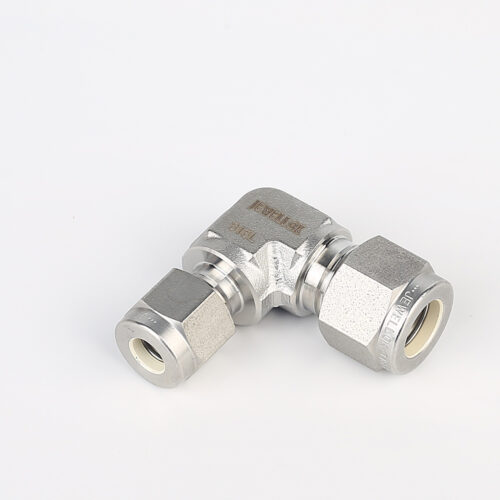
765LR Reducing Tee | Stainless Steel 316 High Purity Butt Weld Fittings Metal Face Seal For Welding Pipe Fitting Reducing Tee
-
Semi Automatic And Automatic Switching Speicialty Gas Changeover Manifold Panel With Semiconductor Valve Manifold Box Gas Pressure Regulators
-
763L Stainless Steel High Purity Pressure Reducing Union Fittings And Tubing Pressure Reducing Valve Adjustment