
Valves Manufacturer Tel: +86 13380377051
How Does A Helium Gas Pressure Regulator Work?
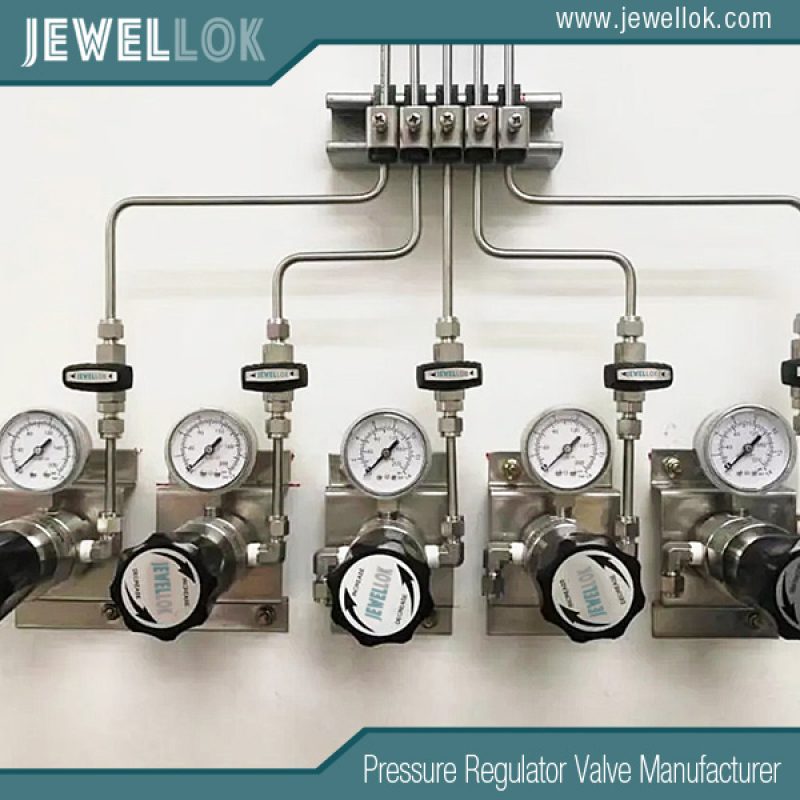
Helium gas pressure regulators are essential devices in various industries, from party balloon inflation to sophisticated scientific applications. At their core, these regulators serve a critical function: they reduce the high pressure of helium stored in cylinders—often exceeding 2,000 pounds per square inch (psi)—to a safer, more manageable level for end-use equipment. Helium, being the second lightest element and an inert gas, is widely used due to its non-reactive properties, low density, and unique physical characteristics. However, handling it requires precise control to prevent leaks, ensure safety, and maintain efficiency.
Understanding how a helium gas pressure regulator works begins with grasping the broader concept of gas regulation. A pressure regulator is essentially a valve system that automatically adjusts the flow of gas to maintain a consistent outlet pressure, regardless of fluctuations in inlet pressure or demand. For helium specifically, regulators must account for the gas’s small molecular size, which makes it prone to leaking through even minor gaps in standard equipment. This is why specialized helium regulators are designed with tighter seals and materials that minimize escape, reducing waste and costs over time.
The importance of these regulators cannot be overstated. In medical settings, helium-oxygen mixtures (heliox) are used to treat respiratory conditions, requiring precise pressure control for patient safety. In laboratories, helium serves as a carrier gas in gas chromatography (GC), where consistent low-pressure delivery is vital for accurate analyses. Industrially, it’s employed in welding, leak detection, and even rocketry. Without a regulator, releasing helium directly from a cylinder could lead to explosive decompression, equipment damage, or asphyxiation in enclosed spaces due to helium’s ability to displace oxygen.
This article delves into the mechanics of helium gas pressure regulators, exploring their principles, components, operation, types, applications, safety considerations, and maintenance. By the end, readers will have a comprehensive understanding of these devices, grounded in engineering principles and practical insights.
Basic Principles of Pressure Regulation
The working principle of a helium gas pressure regulator revolves around the balance of forces to achieve pressure reduction. High-pressure helium from the cylinder enters the regulator, where it’s throttled down to a lower, user-set outlet pressure. This is accomplished through a dynamic equilibrium between mechanical and pneumatic forces.
Fundamentally, regulators operate on the concept of pressure reduction via a controlled orifice. When helium flows into the regulator, it encounters a valve that restricts its passage, creating a pressure drop. The key to consistency lies in the regulator’s ability to self-adjust: as outlet pressure changes due to demand or inlet variations, the device responds to restore balance.
Consider a single-stage regulator as an example. It uses a spring-loaded diaphragm to sense and control pressure. The user adjusts a knob or screw, which compresses a spring, applying force to one side of the diaphragm. On the opposite side, the outlet gas pressure pushes back. When these forces equalize—with the spring force countering the gas pressure—the valve stabilizes at a position that maintains the desired output. If demand increases (e.g., more helium is drawn for balloon filling), outlet pressure drops momentarily, reducing the force on the diaphragm. The spring then pushes the diaphragm further, opening the valve wider to allow more gas flow until balance is restored.
For helium, additional principles come into play. As an inert gas with tiny molecules, it exhibits high diffusivity, meaning it can permeate materials or escape through micro-leakages more easily than heavier gases like nitrogen. Regulators for helium often undergo rigorous helium leak testing using mass spectrometers to ensure inboard (atmosphere to regulator) and outboard (regulator to atmosphere) leak rates are minimal, typically in the range of 10^-9 cc/sec or lower. This testing prevents contamination and gas loss, which is crucial for high-purity applications.
Another principle is the “supply-pressure effect” or “decaying inlet characteristic.” As the cylinder depletes, inlet pressure drops, potentially causing a slight rise in outlet pressure in single-stage regulators—about 1% of the pressure change. Dual-stage designs mitigate this by performing reduction in two steps, achieving variations as low as 0.05%.
Droop, or the slight decrease in outlet pressure with increasing flow, is another factor. Caused by nonlinearities in the spring and diaphragm, it’s minimized in high-quality regulators. For helium in low-flow scenarios like GC (hundreds of mL/min), droop is negligible, but in high-flow uses like balloon inflation, it’s more pronounced.
Overall, these principles ensure safe, efficient helium delivery, adapting to real-world variables like temperature changes (which affect gas density) and flow rates.
Components of a Helium Gas Pressure Regulator
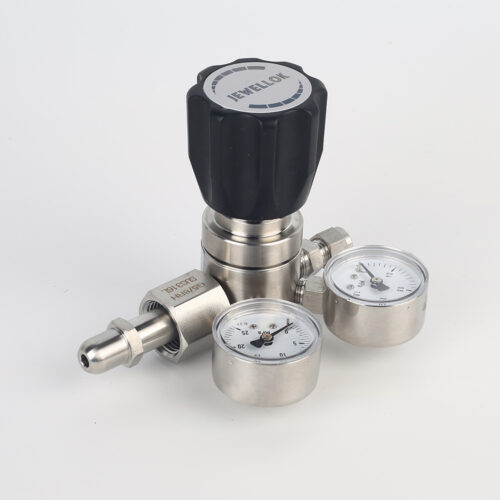
A helium gas pressure regulator comprises several key components that work in concert to control pressure. Understanding these parts is vital for appreciating the device’s functionality.
The body forms the regulator’s housing, typically made from brass, aluminum, or stainless steel. For helium, barstock bodies are preferred over forged ones due to their lower internal volume, tighter grain structure, and smoother surface finish (low Ra), which reduce contamination risks in high-purity setups. Brass is common for non-corrosive gases like helium, while stainless steel is used in ultra-high-purity applications to prevent outgassing.
The inlet and outlet ports connect the regulator to the cylinder and downstream equipment. Inlet fittings must match the cylinder’s Compressed Gas Association (CGA) connection— for helium, it’s typically CGA 580 for standard pressures or CGA 680 for high-pressure (up to 3,500 psi) cylinders. Outlets vary based on application, such as hose barbs for balloons or threaded connections for lab instruments.
Central to operation is the control element, often a poppet or main valve. This valve adjusts the orifice size to throttle gas flow. It’s actuated by the sensing element and seals against a seat (usually fluoropolymer for helium to ensure tight closure without leakage).
The sensing element is typically a diaphragm, either elastomeric (e.g., neoprene or Viton for general use) or metal (stainless steel for high purity). The diaphragm divides the regulator into high- and low-pressure chambers, sensing outlet pressure changes. For helium, metal diaphragms are favored as they don’t offgas contaminants and resist permeation.
The loading mechanism includes a spring and adjustment knob or screw. The spring applies force to the diaphragm, set by turning the knob clockwise to increase pressure. This mechanism allows precise control, with adjustments in small increments.
Pressure gauges are crucial: one for inlet pressure (monitoring cylinder contents) and one for outlet pressure (verifying delivery). Helium regulators often feature gauges calibrated in psi or bar, with the inlet gauge reading up to 4,000 psi.
Additional components include safety relief valves, which vent excess pressure if the regulator fails, preventing bursts. For helium, excess flow valves shut off flow in case of downstream leaks, averting asphyxiation risks. Seals, often metal-to-metal for purity, ensure no leaks; elastomeric seals are used in less critical applications but degrade faster with helium.
In specialty designs, purge assemblies allow flushing with inert gas during cylinder changes, protecting against moisture or air ingress that could contaminate helium lines. These components collectively ensure the regulator’s reliability, with materials chosen for helium’s inertness—no special corrosion resistance needed, but emphasis on leak-proofing.
Working Mechanism: Step by Step
The operation of a helium gas pressure regulator can be broken down into sequential steps, illustrating how components interact to deliver controlled pressure.
First, installation: Attach the regulator to the helium cylinder’s valve using the correct CGA fitting. Ensure the inlet is clean to avoid particulates entering the system. Never open the cylinder valve without the regulator attached, as this could cause rapid decompression.
Step 1: Initial Setup (No Flow). With the adjustment knob fully withdrawn, the spring exerts no force on the diaphragm. The poppet valve remains seated, blocking high-pressure helium (e.g., 2,200 psi) from entering the low-pressure chamber. Outlet pressure is zero.
Step 2: Pressure Adjustment. Turn the knob clockwise, compressing the spring. This force displaces the diaphragm downward, pushing the poppet valve off its seat. Helium flows through the opened orifice into the outlet chamber, building pressure.
Step 3: Force Balance. As outlet pressure rises, it exerts an upward force on the diaphragm, countering the spring. When these forces equilibrate (spring force = outlet pressure × diaphragm area), the valve stabilizes, maintaining the set pressure (e.g., 50 psi for balloon inflation).
Step 4: Responding to Demand. If helium is drawn (e.g., via a nozzle), outlet pressure drops slightly. This reduces the upward force on the diaphragm, allowing the spring to push it further down, opening the valve wider. More gas flows until balance restores. Conversely, if flow stops, pressure builds, pushing the diaphragm up to close the valve partially or fully.
In single-stage regulators, this process occurs in one chamber, making them suitable for applications with stable inlet pressure. However, as the cylinder empties, inlet pressure decays, requiring occasional readjustment.
Dual-stage regulators enhance stability. The first stage reduces pressure to an intermediate level (e.g., 300-500 psi), using its own diaphragm and valve. The second stage then fine-tunes to the final outlet pressure. This setup minimizes supply-pressure effects, ensuring outlet variations under 1 psi even as cylinder pressure drops
For helium, the mechanism includes leak mitigation. Small molecules mean regulators must have low dead volume and tight seals. During operation, if pressure exceeds safe limits, the relief valve activates, venting helium safely.
Shutdown involves closing the cylinder valve, venting residual pressure through a purge valve (if equipped), and backing out the adjustment knob to relax the spring, preventing diaphragm fatigue. This step-by-step process ensures precise, safe helium delivery.
Types of Helium Gas Pressure Regulators
Helium regulators come in various types, tailored to specific needs.
Single-Stage Regulators: Reduce pressure in one step. Economical and simple, they’re ideal for short-term uses like party balloons or light-duty welding. However, they exhibit more droop and supply-pressure effects.
Dual-Stage Regulators: Offer superior stability for long-term or precision applications, such as GC or medical gas delivery. The two-step reduction maintains constant output despite cylinder depletion.
High-Purity and Ultra-High-Purity Regulators: Essential for semiconductor manufacturing or analytical labs where helium purity (99.995%+) must be preserved. Features include stainless steel diaphragms, barstock bodies, and metal-to-metal seals to minimize contamination.
Line Regulators: Installed in gas distribution lines for point-of-use control, often in labs supplying multiple instruments.
Specialty Types: High-flow for rapid balloon filling, low-pressure for sensitive detectors, or lecture bottle regulators for small helium containers. Back-pressure regulators prevent overpressurization in systems.
Helium-specific designs prioritize low leak rates, with materials inert to the gas.
Applications for Helium
Helium regulators enable diverse uses. In entertainment, they control flow for balloon inflation, with auto-fill features for foils. Scientifically, as a carrier gas in GC, regulators ensure stable low pressures for detectors like FID or TCD. Medically, they deliver heliox mixtures. Industrially, in welding (shielding gas) or leak testing, precise regulation prevents waste.
Safety and Maintenance
Safety is paramount with helium regulators. Use only compatible fittings to avoid accidents. Monitor gauges for anomalies; zero-offset indicates damage—discard immediately. In enclosed areas, excess flow valves prevent asphyxiation.
Maintenance includes regular leak checks, cleaning inlets, and replacing seals. Purge systems during cylinder changes to avoid contamination. Follow manufacturer guidelines for longevity.
Conclusion
Helium gas pressure regulators are ingenious devices that balance forces to deliver safe, consistent gas flow. From basic principles to advanced types, they underpin countless applications, ensuring efficiency and safety in handling this valuable resource.
For more about how does a helium gas pressure regulator work, you can pay a visit to Jewellok at https://www.jewellok.com/ for more info.
-
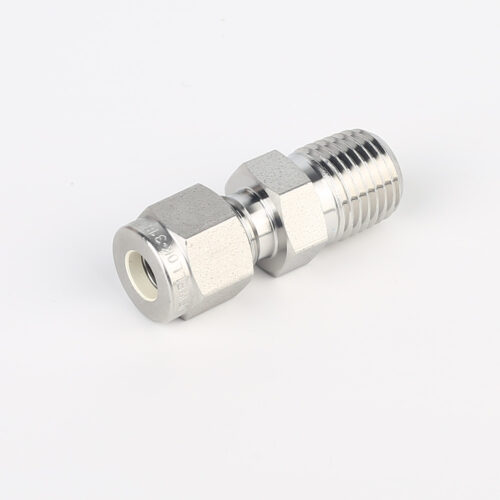
768L Stainless Steel Male Tube Butt Weld Connector | Clean Weld Fittings And Ultra-High Purity Fittings
-
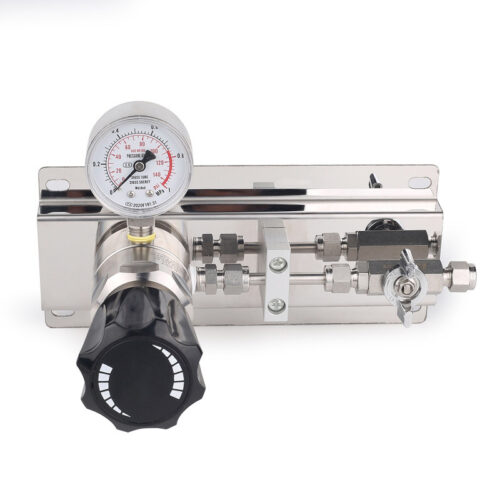
High Purity Gas Cylinder Semi Automatic Changeover Manifold Regulator Panel 3000psig Stainless Steel Gas Control Panel 1/8 Npt With Gauge
-
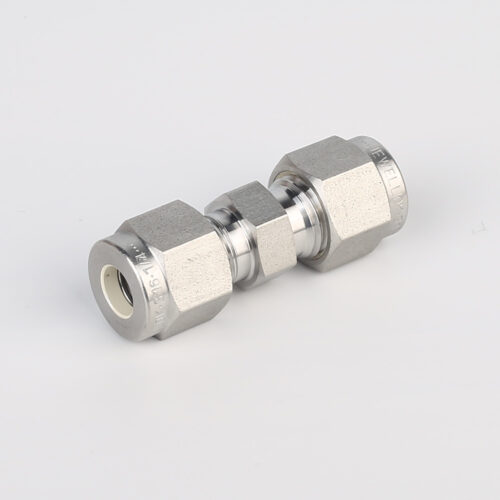
762L Stainless Steel High Purity Union High-Purity Gas System Fittings
-

Integrated Gas System (IGS) Modular Integrated Gas Systems (TMS) Integrated Gas Supply System For Semiconductor And Laboratory
-
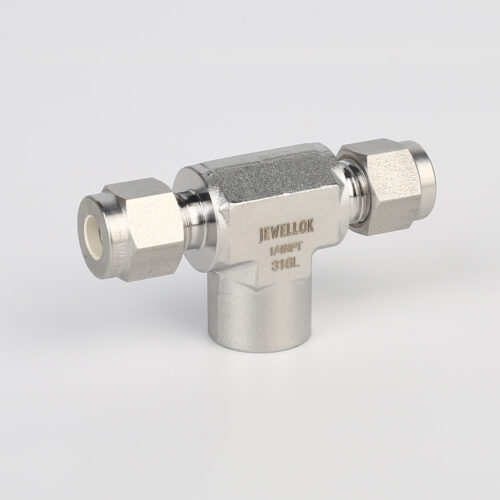
772 LF Female Branch Tee | Stainless Steel Tube Fitting Female Branch Tee 1/2 in. Tube OD x 1/2 in. Tube OD x 3/8 in. Female NPT
-
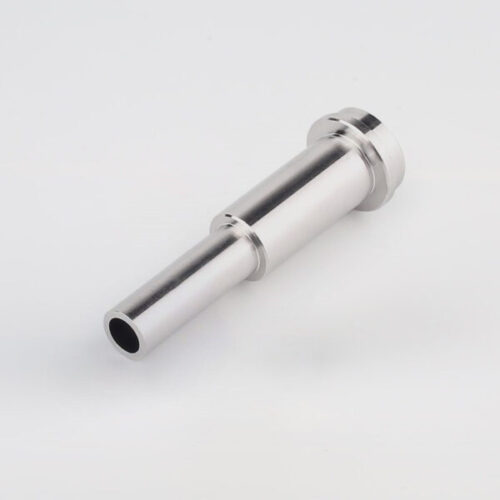
Long Gland LG Series For Ultra High Purity Gas And Chemical Delivery Systems
-
High Purity High Pressure Gas Cylinder Pressure Regulators Pressure Reducing Valve JSR-1E Series
-
Fully Automated Gas Cabinet For Precise UHP Gas Delivery And High Purity Gas Delivery Systems JW-300-GC