
Valves Manufacturer Tel: +86 13380377051

Precision Flow: The Engineering Architecture of Modern Chemical Delivery Systems (CDS)
In the realm of semiconductor fabrication, photovoltaic production, and pharmaceutical synthesis, the “process fluid” is the lifeblood of the facility. A Chemical Delivery System (CDS) is not merely a pump and a pipe; it is a sophisticated, automated infrastructure designed to transport hazardous, ultra-high-purity (UHP) liquid chemicals from bulk storage to point-of-use (POU) tools with zero contamination and absolute volumetric precision.
As nodes shrink toward 2nm and below, the margin for error in chemical delivery has evaporated. A single metallic impurity at the parts-per-trillion (ppt) level or a microscopic pressure fluctuation can lead to catastrophic yield loss.
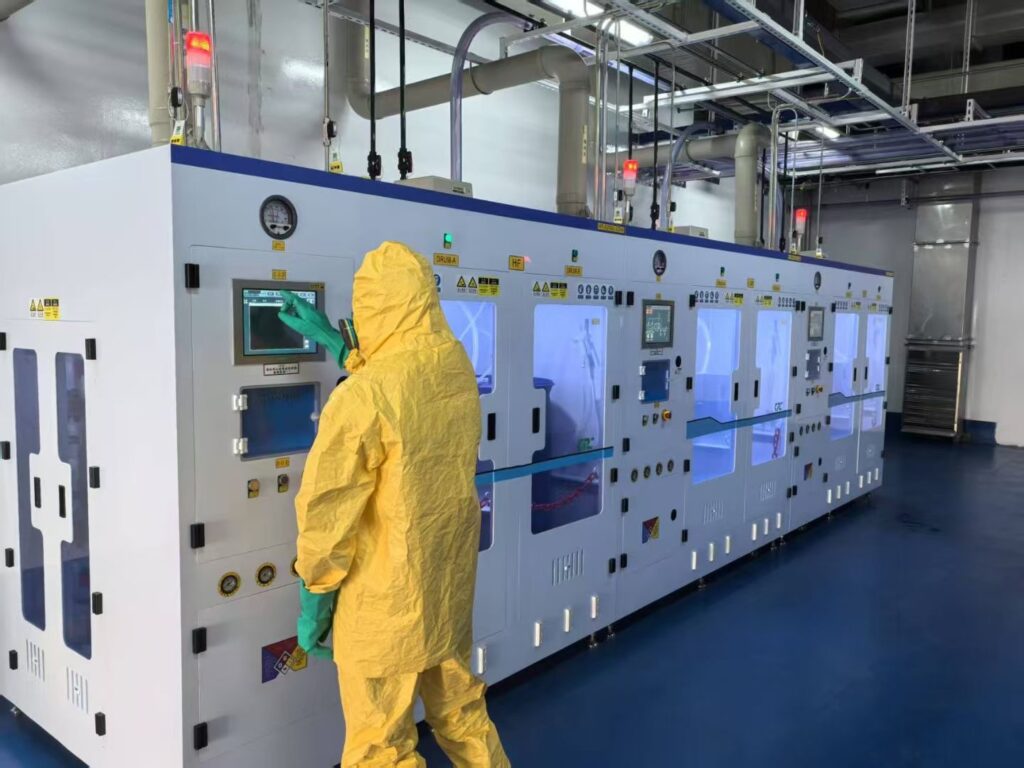
- The Functional Hierarchy of a CDS
A robust Chemical Delivery System is generally divided into three functional stages: Bulk Storage, Conditioning/Blending, and Distribution.
Bulk Storage and Supply
The system begins with the source—typically a drum, a 1000L IBC (Intermediate Bulk Container), or a massive ISO tank. Modern CDS units utilize dual-alternating supply configurations. While one drum is online, the other remains in standby. Automated switchover valves ensure a continuous, bubble-free flow, preventing “dry-run” scenarios that could damage expensive downstream process tools.
Conditioning and Blending
Many chemicals, such as etchants (HF, KOH) or cleaning agents (SC-1, SC-2), are shipped in concentrated forms to save costs. The Chemical Delivery Module (CDM) within the system performs automated dilution. Using high-precision flow meters and conductivity sensors, the system blends concentrated chemicals with deionized water (DIW) to reach exact molarities.
Distribution (VMBs)
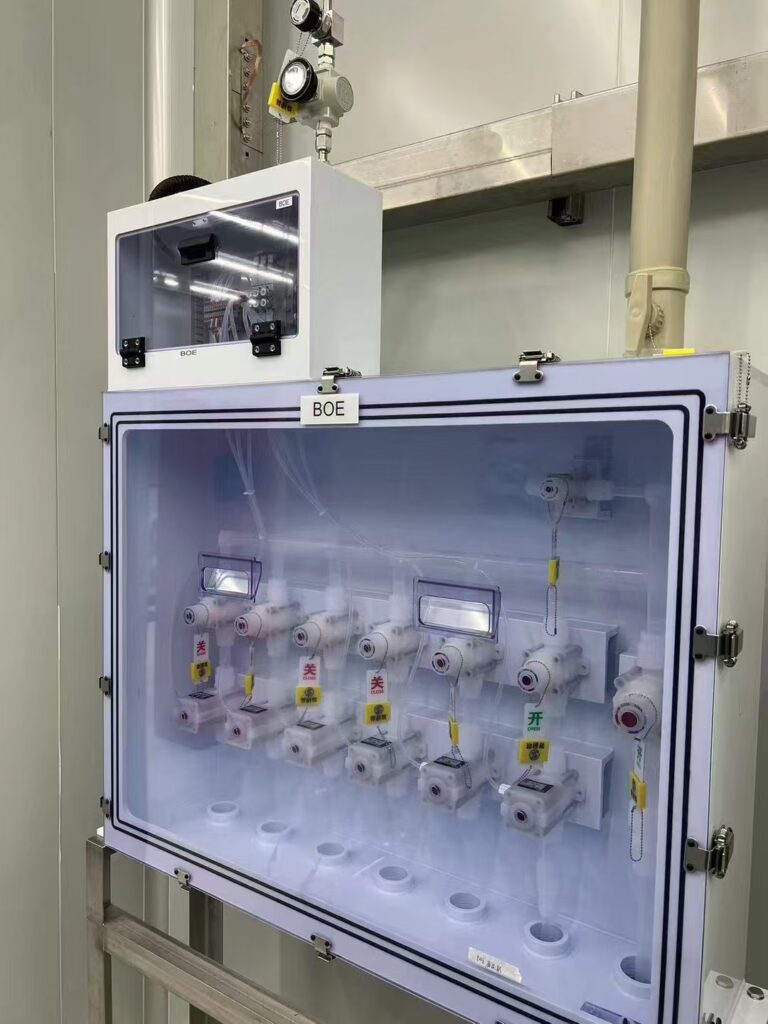
The final stage involves the Valve Manifold Box (VMB). This localized enclosure branches a single supply line into multiple outputs. Each output is independently metered and valved, allowing a single CDS to feed an entire bay of process tools while maintaining the ability to isolate an individual tool for maintenance without halting the entire line.
- Materials Science: The War Against Contamination
The primary enemy of a CDS is the system itself. Interaction between the chemical and the delivery hardware can cause “leaching” or “shedding.”
- 316L Electropolished Stainless Steel: For organic solvents, 316L stainless steel is the standard. However, standard finishes are insufficient. UHP systems require electropolished (EP)surfaces with a roughness average (Ra) of 5 micro-inches or less. This mirror-like finish removes the “peaks and valleys” where bacteria or particles could hide.
- Fluoropolymers (PFA/PTFE): For aggressive acids and bases that would corrode metal, high-purity PFA (Perfluoroalkoxy) is used. PFA is chemically inert and features extremely low trace-metal extractables, ensuring that the chemical arriving at the wafer is as pure as it was in the sealed drum.
- Core Components and Fluid Dynamics
To achieve ppt-level purity, the mechanical components must be “dead-space free.”
- UHP Diaphragm Valves: Unlike ball valves, which can trap chemicals in the rotating mechanism, diaphragm valves provide a seamless flow path. They are designed for millions of cycles without generating friction-based particles.
- Magnetic Levitation Pumps: Traditional mechanical seals are a source of contamination. Modern CDS units often employ Maglev pumps, where the impeller “floats” in a magnetic field. There is no physical contact between moving parts, eliminating wear-induced particles and heat transfer to the chemical.
- Degassing Units: Bubbles in a delivery line can cause “micro-masking” on a semiconductor wafer, leading to pattern defects. Integrated membrane degassers remove dissolved gases from the liquid stream before it reaches the tool.
- Safety and Environmental Controls
Handling flammable solvents and toxic acids requires a “fail-safe” engineering philosophy.
- Secondary Containment: Every CDS is housed in a cabinet with a leak-tight base (sump). In the event of a primary line failure, the chemical is contained and routed to a dedicated drain.
- Nitrogen (N2) Blanketing: For flammable liquids, the “headspace” of the supply tank is filled with inert nitrogen. This displaces oxygen, removing the possibility of combustion.
- Exhaust Monitoring: Cabinets are constantly under negative pressure. Sensors monitor the exhaust for chemical vapors, triggering an immediate pneumatic shutdown if a leak is detected.
5.Automation and Industry 4.0 Integration
The modern CDS is a “smart” node in the factory’s network. Using PLC (Programmable Logic Controller) systems, facility managers can monitor:
- Real-time Flow Rates: Ensuring the process tool receives exactly what the recipe requires.
- Totalizer Data: Predicting when a drum will empty to optimize logistics.
- Predictive Maintenance: Monitoring valve actuation times to replace components beforethey fail.
Conclusion
The Chemical Delivery System is the unsung hero of advanced manufacturing. While the focus is often on the process tools themselves, those tools are only as effective as the chemicals fed to them. By combining extreme materials science, no-contact pumping technologies, and rigorous safety automation, the CDS ensures that the bridge between bulk chemistry and microscopic precision remains untainted.
As the industry moves toward greener chemistry and even tighter purity standards, the CDS will evolve further, integrating AI-driven leak prediction and closed-loop recycling systems to minimize waste and maximize yield.
For more about liquid chemical delivery systems (CDS), you can pay a visit to Jewellok at https://www.jewellok.com/product-category/chemical-delivery-system/ for more info.
-
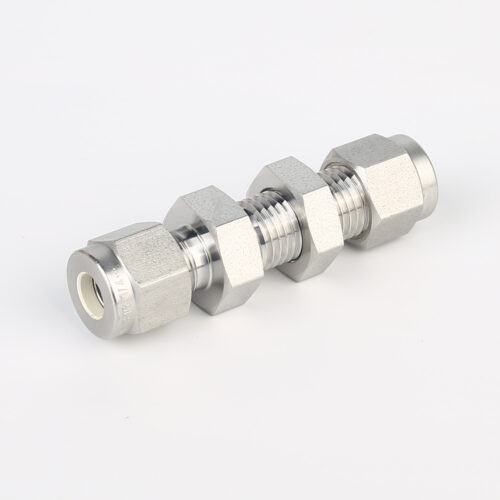
774L Stainless Steel UHP Fittings Butt Weld Bulkhead Union For High Flow Special Gas Fluid
-
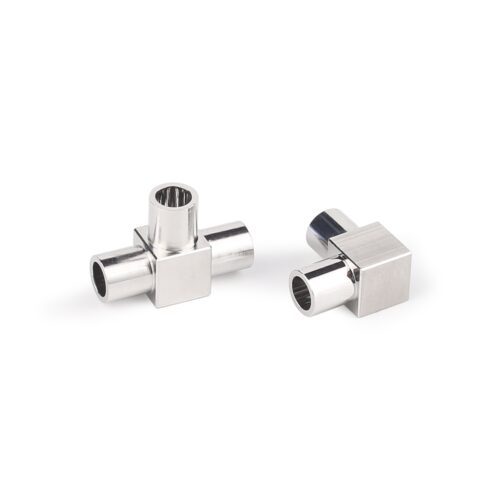
Stainless Steel Mini Elbow Mini Tee Mini Cross Mini Tribow Ultrahigh Purity Mini Butt Weld Fittings
-
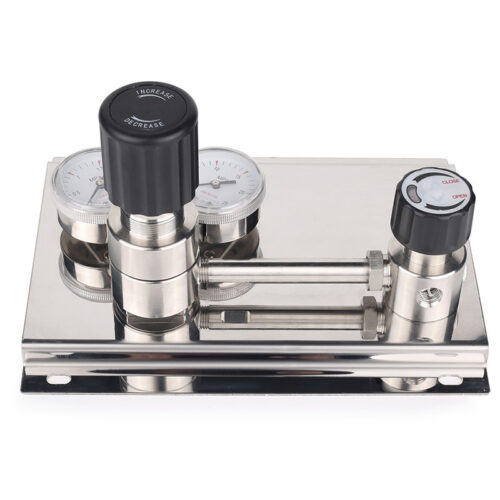
Stainless Steel Fully Automatic Gas Switchover Manifold System Automatic Gas Cylinder Switchover Co2 Cylinder Auto Changeover Controller
-
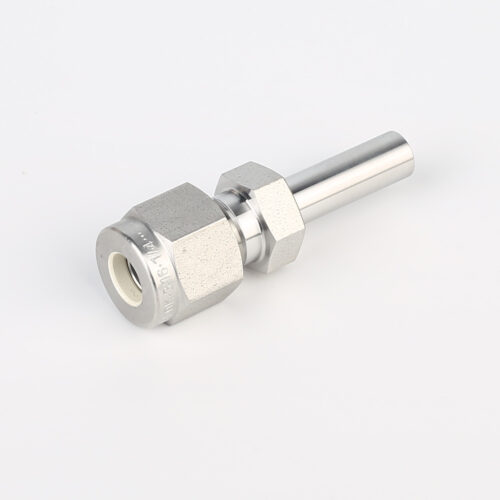
767LT Reducer Pressure Reducing Valve Adjustment High purity Pressure Reducing Union Fittings And Tubing
-
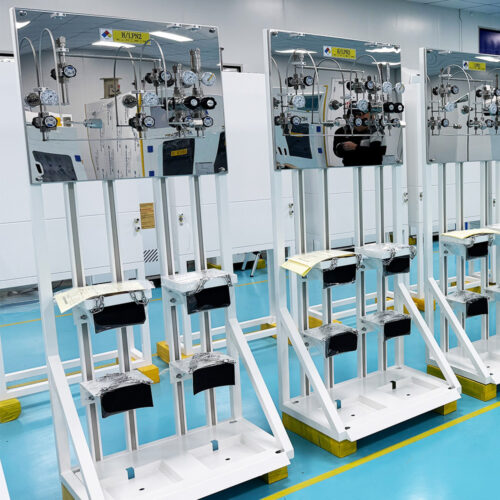
Semi-Automatic VMB Gas Cabinet With Semiconductor Valve Manifold Box Diaphragm Valves And Gas Pressure Regulators
-
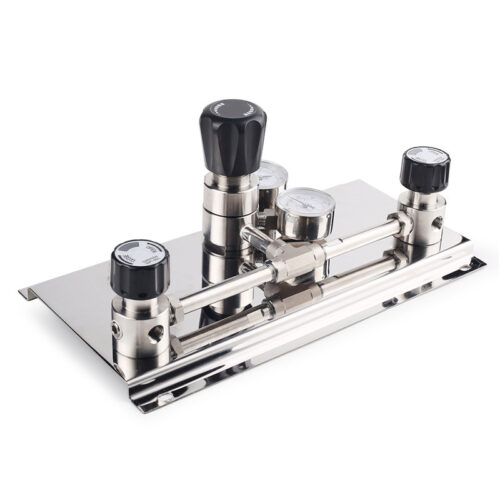
Hydrogen Manifold Argon Gas Manifold System Oxygen Manifold Propane Gas Manifold With Valves In Gas Manifold Changeover System
-
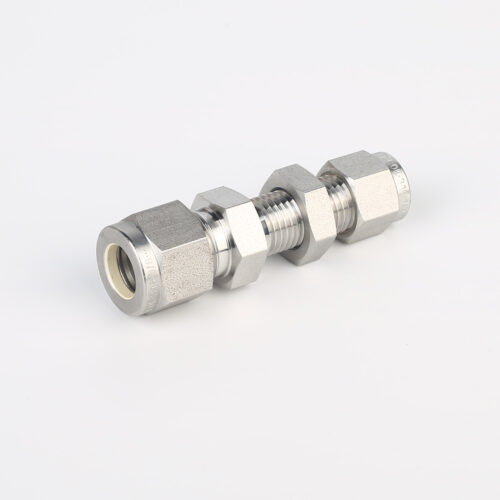
775L Bulkhead Reducing Union | Stainless Steel High Purity Double Ferrule Bulkhead Reducing Unions
-
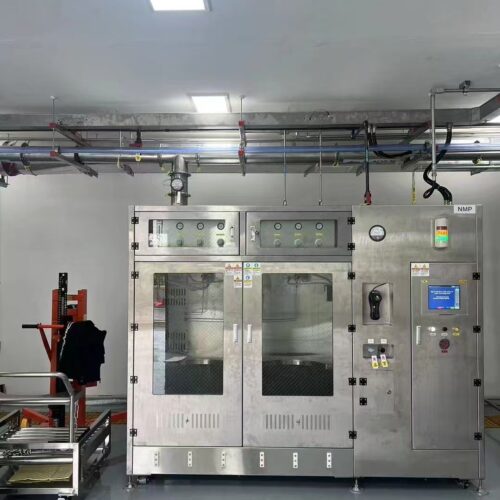
316L Electropolished Chemical Delivery System (CDS) for Contamination-Free Liquid Handling in EV Battery Manufacturing Plants