
Valves Manufacturer Tel: +86 13380377051
How to Design a Laboratory Gas Pipeline System for Safe Gas Delivery
A laboratory gas pipeline system is a critical part of modern laboratory infrastructure. It provides a controlled and reliable method for transporting gases such as nitrogen, oxygen, hydrogen, helium, argon, carbon dioxide, compressed air, and specialty gases from cylinders, bulk storage, or centralized gas supply systems to laboratory instruments and workstations.
Unlike ordinary utility piping, laboratory gas piping must be designed around gas properties, pressure requirements, purity levels, compatibility, leakage prevention, ventilation, and user safety. A well-designed laboratory gas pipeline system can reduce cylinder handling, maintain stable gas pressure, improve gas purity, and support continuous laboratory operation.
This article explains the key principles for designing a safe and reliable laboratory gas delivery system, from gas selection and pipeline sizing to pressure control, material selection, installation, testing, and maintenance.
1. Define Laboratory Gas Requirements
The first step in designing a laboratory gas pipeline system is to establish the actual gas requirements of the laboratory.
Different laboratories have significantly different gas consumption and purity requirements. A university chemistry laboratory may primarily require nitrogen, compressed air, and oxygen, while an analytical laboratory may need nitrogen, hydrogen, helium, argon, and high-purity specialty gases for instruments such as GC, GC-MS, ICP, LC-MS, and other analytical equipment.
Before designing the pipeline, identify:
- Gas type and chemical properties
- Required gas purity
- Supply pressure
- Operating pressure
- Maximum allowable pressure
- Peak and average flow rate
- Number of gas outlets
- Simultaneous gas demand
- Distance between gas source and laboratory
- Future expansion requirements
- Required monitoring and alarm functions
Gas consumption should be calculated based on both normal operating conditions and peak demand. Designing only for the current average flow can result in pressure instability when multiple instruments operate simultaneously.
For laboratories expecting future expansion, additional capacity should be incorporated into the initial design where practical.
2. Separate Gas Sources and Distribution Zones
A laboratory gas pipeline system normally consists of several functional sections:
Gas source → pressure regulation → gas distribution manifold → main pipeline → branch pipeline → terminal valve → equipment
The gas source may include high-pressure cylinders, cylinder bundles, liquid gas tanks, generators, or centralized gas supply systems.
For cylinder-based systems, an automatic or semi-automatic gas changeover manifold can maintain continuous supply by switching from an empty cylinder bank to a standby bank.
The distribution system should be divided into appropriate zones. For example, gases with different pressure or purity requirements should not simply share the same distribution configuration.
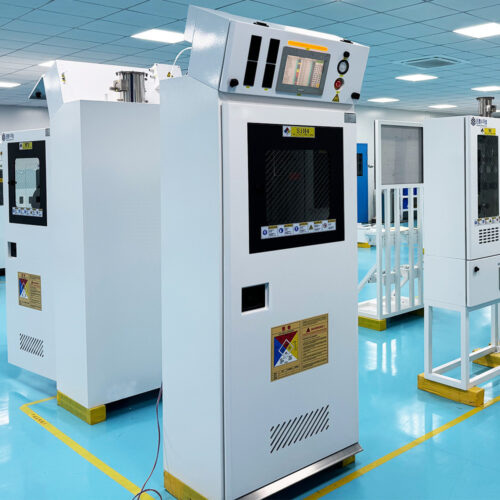
Toxic, corrosive, flammable, oxidizing, and inert gases require different safety considerations. Specialty gases should be isolated where necessary and supplied through compatible components.
3. Select Suitable Pipeline Materials
Pipeline material selection is one of the most important aspects of laboratory gas system design.
Common materials include stainless steel, copper, and specialized polymer tubing. The correct choice depends on gas properties, pressure, purity requirements, temperature, and application.
Stainless Steel
316L stainless steel is widely used for high-purity and specialty gas applications because it provides good corrosion resistance, mechanical strength, and compatibility with many laboratory gases.
For ultra-high-purity gas delivery, internally polished stainless-steel tubing can help reduce particle generation, adsorption, moisture retention, and contamination.
Copper
Copper tubing can be used in suitable laboratory applications, particularly for gases where copper compatibility and purity requirements are acceptable. However, material compatibility should always be evaluated against the specific gas.
Polymer Materials
Certain polymer materials may be suitable for low-pressure laboratory applications or specific chemically aggressive gases. However, permeability, chemical compatibility, pressure limitations, and contamination characteristics must be considered.
The pipeline material should never be selected only according to cost. The gas chemistry and required purity should be the primary considerations.
4. Calculate Pipeline Diameter and Pressure Drop
Pipeline diameter directly affects gas velocity and pressure loss.
If the pipeline is too small, pressure drop can become excessive, especially when several instruments operate simultaneously. If it is significantly oversized, the larger internal volume may increase installation costs and can create unnecessary gas inventory.
Pipeline sizing should consider:
- Gas flow rate
- Supply pressure
- Operating pressure
- Pipeline length
- Number of fittings
- Gas density
- Temperature
- Pressure drop
- Simultaneous demand
The total pressure loss includes straight-pipe friction as well as losses from elbows, tees, valves, regulators, filters, and other fittings.
For high-purity applications, the design should also minimize unnecessary dead legs and internal cavities. A compact distribution layout can improve gas replacement efficiency and reduce contamination risks.
5. Use a Multi-Stage Pressure Control Architecture
High-pressure cylinders cannot normally be connected directly to laboratory instruments. A pressure reduction and control system is required.
A typical system uses a primary pressure regulator near the gas source and secondary pressure regulation closer to the point of use.
A multi-stage pressure control architecture can provide better control when the source pressure is significantly higher than the equipment operating pressure.
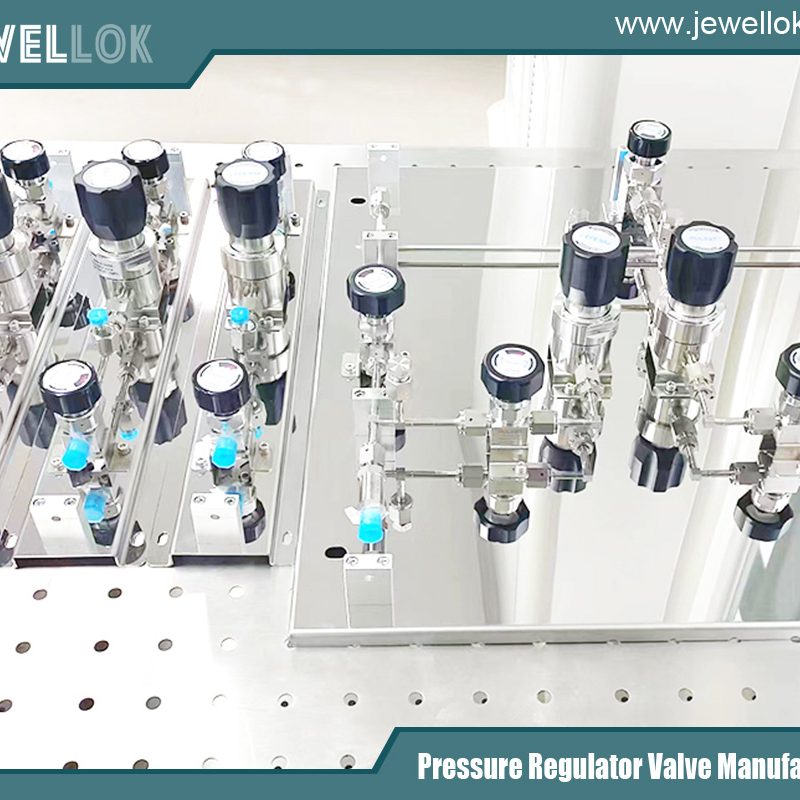
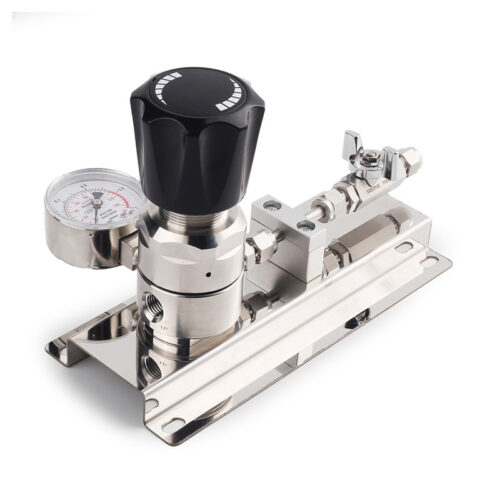
A laboratory gas pressure control panel may integrate:
- Pressure regulators
- Isolation valves
- Pressure gauges
- Pressure sensors
- Relief valves
- Filters
- Check valves
- Purge connections
- Automatic changeover components
- Gas monitoring interfaces
The regulator should be selected according to inlet pressure, outlet pressure, flow rate, gas compatibility, connection type, and required purity.
For corrosive or reactive gases, wetted components must be made from materials compatible with the gas.
6. Choose Appropriate Valves and Fittings
Valves are essential for isolating, controlling, purging, and maintaining laboratory gas pipelines.
Common valve types include ball valves, diaphragm valves, needle valves, check valves, and pressure relief valves.
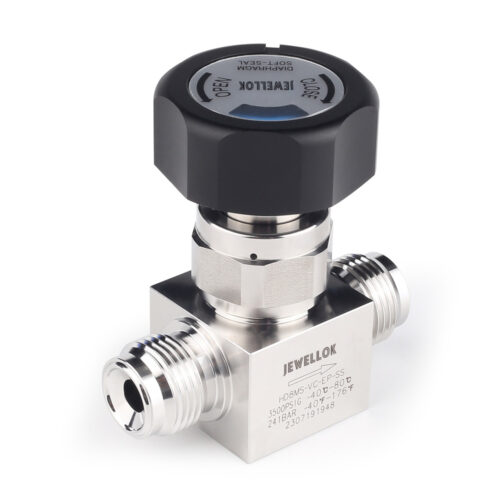
For high-purity gas applications, diaphragm valves are often used because their internal design can reduce contamination and minimize potential leakage paths.
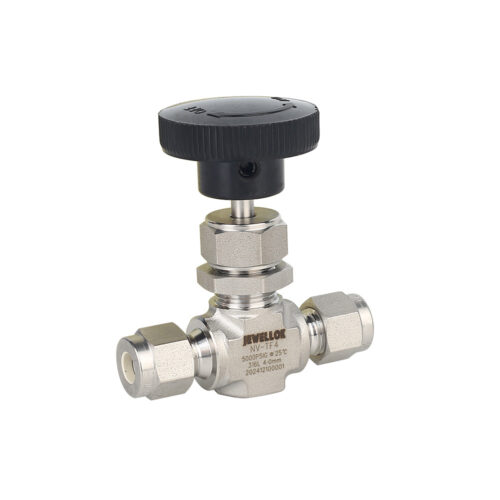
Needle valves are useful where precise low-flow adjustment is required.
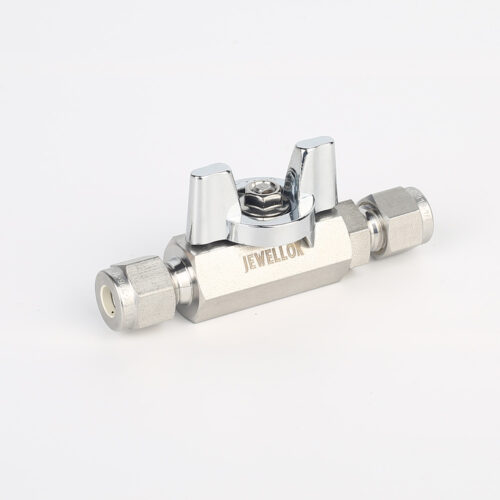
Ball valves are commonly used for isolation because they provide quick shutoff and relatively low pressure drop.
Every valve should be selected according to its intended function rather than using one valve type throughout the entire system.
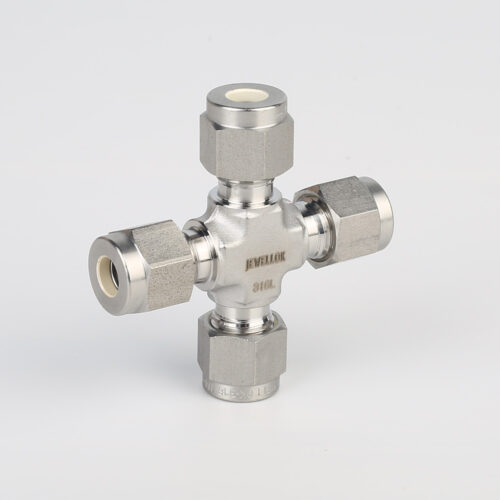
Connection technology is also important. Compression fittings, VCR-type connections, orbital-welded tubing, and other connection methods may be selected according to pressure, purity, and maintenance requirements.
For high-purity systems, orbital welding can provide a clean and consistent connection when properly performed.
7. Design for Gas Purity
Gas purity is especially important for analytical instruments, semiconductor laboratories, research facilities, and other sensitive applications.
Even when the gas supplied from the cylinder has extremely high purity, contamination can occur inside the distribution system.
Potential contamination sources include:
- Moisture
- Oxygen
- Hydrocarbons
- Particles
- Improperly cleaned tubing
- Elastomer outgassing
- Dead legs
- Poorly sealed connections
- Incompatible materials
The pipeline should therefore be designed with a clean internal surface and an appropriate component configuration.
High-purity systems may require cleaned and passivated tubing, high-integrity diaphragm valves, suitable filters, and controlled installation procedures.
The system should also minimize unnecessary branches and stagnant sections where contaminants can accumulate.
8. Incorporate Purging and Venting
A properly designed laboratory gas pipeline should include appropriate purging provisions.
Purging may be required during:
- Initial commissioning
- Cylinder replacement
- Maintenance
- Component replacement
- Gas changeover
- Shutdown
- Contamination recovery
Inert gases such as nitrogen can be used for suitable purge procedures, depending on the system design and gas compatibility.
However, purge gas must be safely discharged. Vent lines should be routed to an appropriate location and designed to prevent hazardous gas accumulation inside the laboratory.
Toxic, flammable, oxygen-deficient, or otherwise hazardous gases require particularly careful vent and exhaust design.
9. Provide Leak Detection and Safety Monitoring
Gas leakage is one of the most important hazards associated with laboratory gas systems.
The consequences depend on the gas involved. A leak of inert gas can create an oxygen-deficient environment, while hydrogen and other flammable gases may create a fire or explosion hazard. Toxic or corrosive gases can directly threaten personnel.
The laboratory gas pipeline system should therefore be coordinated with appropriate safety systems.
Depending on the application, these may include:
- Gas detectors
- Oxygen deficiency monitors
- Pressure alarms
- Automatic shutoff valves
- Emergency isolation systems
- Local visual alarms
- Audible alarms
- Central monitoring systems
- Ventilation interlocks
Gas detectors should be positioned according to the physical characteristics of the gas. For example, the location of a detector should consider whether the gas is lighter or heavier than air and how laboratory ventilation moves air through the room.
10. Design the Gas Cylinder Connection Area Carefully
Gas cylinders should be securely restrained and installed in an appropriate location.
The cylinder storage and connection area should provide sufficient ventilation and allow operators to safely replace cylinders.
Cylinders should be separated or controlled according to gas classification and compatibility.
The connection area should normally include appropriate isolation valves, pressure regulation, flexible connections where required, and labeling.
Cylinder connections should be protected from mechanical damage, and hoses or tubing should be compatible with the gas and pressure.
For multiple-cylinder systems, a gas manifold can simplify distribution and reduce the need for frequent manual connection and disconnection.
11. Clearly Label the Pipeline System
Every gas pipeline should be clearly identified.
Labels should indicate the gas name and, where appropriate, direction of flow, pressure, hazard classification, and service area.
Color coding may be used as an additional identification method, but written gas identification should remain clear because color conventions can vary between organizations and regions.
Terminal outlets should also be clearly marked to prevent accidental connection of equipment to the wrong gas.
For laboratories using multiple specialty gases, cross-connection prevention is particularly important.
12. Install the System According to a Controlled Procedure
Good design can be compromised by poor installation.
Before installation, prepare a detailed piping and instrumentation diagram (P&ID) showing gas sources, regulators, valves, pressure gauges, sensors, pipelines, outlets, vents, and safety devices.
During installation:
- Verify the correct tubing and components.
- Keep tubing interiors clean.
- Protect open tube ends from dust and moisture.
- Follow the specified joining procedure.
- Avoid unnecessary bends and dead legs.
- Support pipelines properly.
- Install valves in accessible locations.
- Maintain correct pipeline identification.
- Separate incompatible services where required.
- Record installation and inspection results.
For high-purity applications, installation should be performed in a controlled environment using appropriate cleaning and handling procedures.
13. Perform Pressure and Leak Testing
The completed laboratory gas pipeline should be tested before being placed into service.
Testing procedures depend on the system design, applicable standards, gas type, pressure rating, and local regulations.
Typical commissioning activities may include:
- Visual inspection
- Pressure testing
- Leak testing
- Valve operation testing
- Regulator testing
- Alarm testing
- Sensor verification
- Purging
- Gas identification verification
- Flow verification
Leak testing is particularly important around regulators, valve stems, fittings, welded joints, instrument connections, and other potential leakage points.
For high-purity systems, helium leak testing or other sensitive leak detection methods may be appropriate when specified by the application.
The test results should be documented as part of the commissioning record.
14. Establish Preventive Maintenance
A laboratory gas pipeline is not a “install-and-forget” system.
Regular inspection helps identify deteriorating components before they create operational or safety problems.
Maintenance schedules should cover:
- Pressure regulators
- Valves
- Flexible hoses
- Filters
- Pressure gauges
- Sensors
- Gas detectors
- Relief devices
- Pipeline supports
- Terminal outlets
- Automatic changeover systems
Regulators and safety devices should be inspected according to manufacturer recommendations and applicable requirements.
Gas detectors should be tested and calibrated at appropriate intervals.
Any modification to the pipeline should be documented so that the P&ID and maintenance records remain accurate.
15. Work With an Experienced Laboratory Gas System Manufacturer
Designing a laboratory gas pipeline system requires more than selecting tubing and valves. It requires an integrated understanding of gas chemistry, pressure control, flow requirements, contamination control, safety engineering, and laboratory operations.
A professional laboratory gas system manufacturer can help evaluate the gas source, calculate pipeline requirements, select compatible components, design pressure control panels, configure gas manifolds, and develop a complete distribution system.
For high-purity and specialty-gas applications, the manufacturer should be able to provide appropriate stainless-steel tubing, regulators, diaphragm valves, fittings, gas panels, automatic changeover systems, and safety monitoring solutions.
The final system should be designed according to the actual laboratory application and applicable local codes and standards rather than using a one-size-fits-all configuration.
Conclusion
A safe laboratory gas pipeline system begins with a detailed understanding of gas properties, consumption, pressure, purity, and laboratory operating conditions. The system should combine correctly sized pipelines, compatible materials, reliable pressure regulators, suitable valves and fittings, effective purging, leak detection, ventilation, clear labeling, and systematic testing.
For high-purity laboratory gas delivery, special attention should be given to internal surface quality, connection integrity, contamination control, dead-leg reduction, and pressure stability. For hazardous gases, gas detection, emergency shutoff, ventilation, and safe exhaust design become essential parts of the overall system.
When properly engineered and maintained, a laboratory gas pipeline system can provide stable gas delivery, improve laboratory efficiency, reduce cylinder handling, and create a safer working environment for researchers and laboratory personnel.
The most effective approach is to treat the gas pipeline as a complete engineered system—from the gas source and pressure control stage to the final equipment connection—rather than as a simple network of pipes and valves.
For more about how to design a laboratory gas pipeline system for safe gas delivery, you can pay a visit to Jewellok at https://www.jewellok.com/ for more info.
-

Liquid Chemical Delivery Module And Chemical Delivery System Semiconductor Chemical Automatic Liquid Supply Equipment
-
Stainless Steel High Purity High Temperature Pneumatic Actuated Ball Valves JBV2 Series
-
Stainless Steel High-Purity High Temperature Metal Seated Ball Valves JBV3 Series
-
Ultra High Purity Trimethylaluminum TMA Gas Cabinet Liquid Delivering Cabinet Used For Specialty Gas Delivery System In Semiconductor
-
Ultra High Purity Stainless Steel Compressed Gas Changeover Manifold Panel System For Integrated Gas Supply System
-
7102L Stainless Steel 316L SS Union Cross Ultra High Purity Long Arm Union Elbow Tee Cross Butt Weld Fittings
-
High Purity High Pressure Stainless Steel Needle Valve Natural Gas Flow Control Valve JNV Series
-
Ultra High Purity High Temperature Low Pressure Manual Diaphragm Valve Configurations Preventing Critical Process Virtual Leaks